

Ann M. Haralambie is a Certified Family Law Specialist, Arizona Board of Legal Specialization, a Certified Child Welfare Law Specialist, National Association of Counsel for Children, and a Martindale-Hubbell AV® Preeminent™ rated attorney in private practice in Tucson, Arizona since 1977. Her practice is restricted to family and child welfare cases, with an emphasis on custody, child abuse, and child advocacy. The practice is child-focused and seeks to minimize the harm which often occurs when child custody is litigated.
Ms. Haralambie is also an author and a national and international speaker and trainer for professional groups on topics related to custody, child abuse, and child advocacy. She serves as a consultant to and member of a number of national organizations dealing with family and child welfare law. She has served in a number of leadership roles within the legal and child welfare communities. (See résumé for details.)
Initial consultations, which generally last between one and two hours, are available for a flat fee of $500. We accept checks, money orders, cash, Zelle, and Paypal only (no credit or debit cards). At this time I doing strictly child-related work (not financial or property cases). NOTE THAT I AM CURRENTLY ACCEPTING ONLY A LIMITED NUMBER OF NEW CLIENTS.
Read my article, for the National Association of Counsel for Children, on some changes I have observed in the child welfare field over the past 40 years and the need to ask state and local legislators about the child welfare system here: As the Pendulum Swings Guardian article
- Paternity (unmarried parents)
- Third party custody and visitation (grandparents, stepparents, foster parents, de facto parents)
- Modification of custody/visitation
- Interstate custody
- Parenting agreements (pre- and post-decree, unmarried parents, LGBT parents)
- Child sexual abuse
- International child abduction (Hague Convention on the Civil Aspects of International Child Abduction)
- Indian Child Welfare Act
- Dependency (DCS)
- Termination of parental rights
- Guardianship of children
- Stepparent adoption
- Private adoption (note: we do not find children or match birth parents)
- Representation of adoption and child welfare agencies
- Appeals
Upcoming speaking/conference schedule:
ABA Family Law Section Fall meeting, Louisville, KY, October 10-12, 2023
Renewal and Revolution: Recommitting the Legal Profession to Serving Children and Youth, Their Families, and Communities Practice (invitation only working meeting), Hofstra University School of Law, Hempstead, NY, October 13-14, 2023
Author event, Madison Library, Madison, NH, October 19, 2024
Author event, Tucson Festival of Books, Tucson, AZ, March 9-10, 2024
ABA Family Law Section Spring meeting, Boston, MA, April 30-May 4, 2024
ABA Family Law Section Fall meeting, Palm Springs, CA, September 24-18, 2024
ABA Family Law Section Spring meeting. White Sulphur Springs, WV, April 6-9, 2025
NOW AVAILABLE:
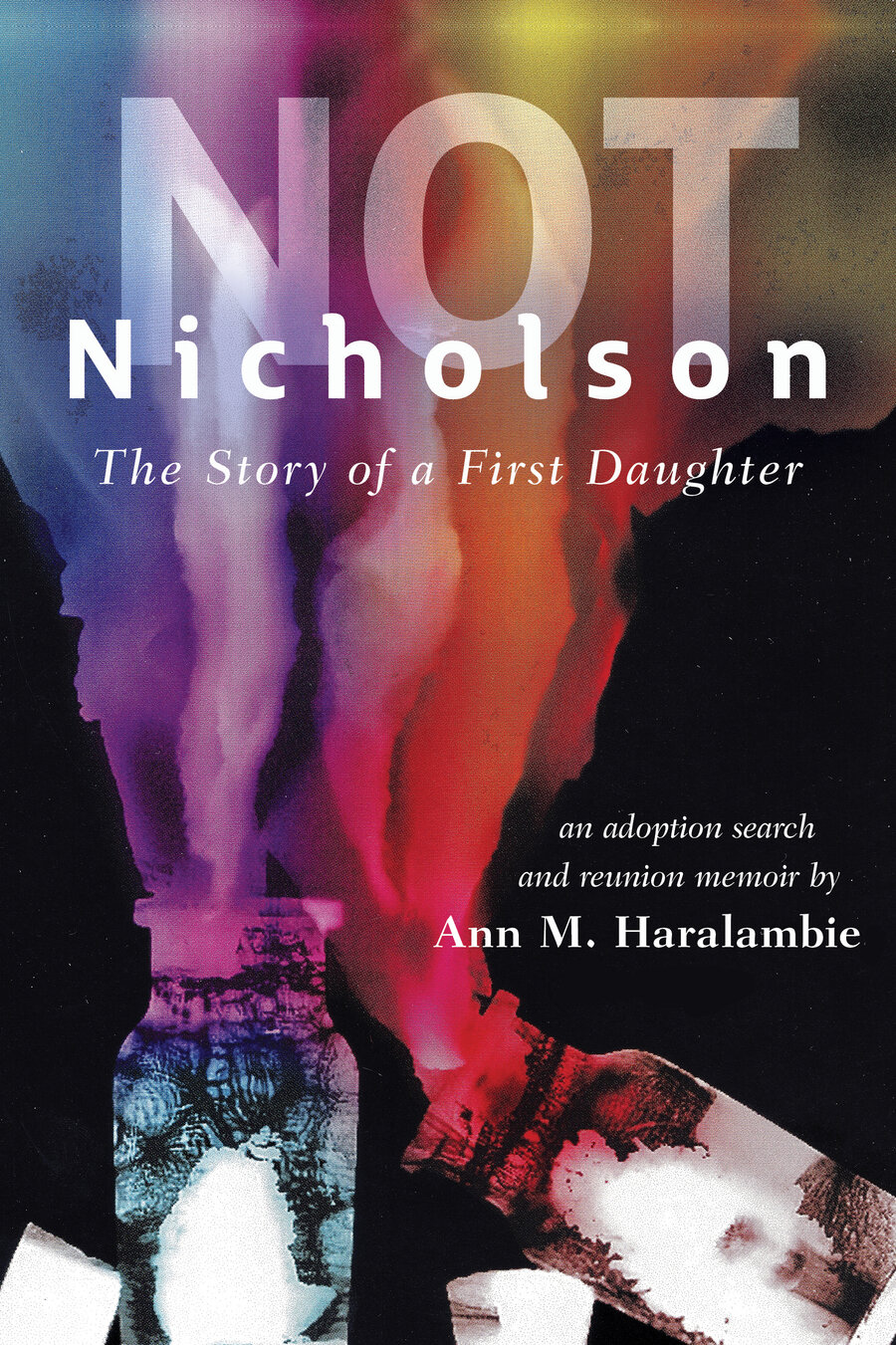
My new, award-winning book, Not Nicholson: The Story of a First Daughter, An Adoption Search and Reunion Memoir (Wheatmark, 2023), is now available from Amazon at https://amzn.to/3Oy1j8R and from all major online book sellers. The book is available as a paperback and eBook (all formats). It is the recipient of a Literary Titan Gold Book Award. If you read the book, please post an honest review or rate it wherever you bought it.